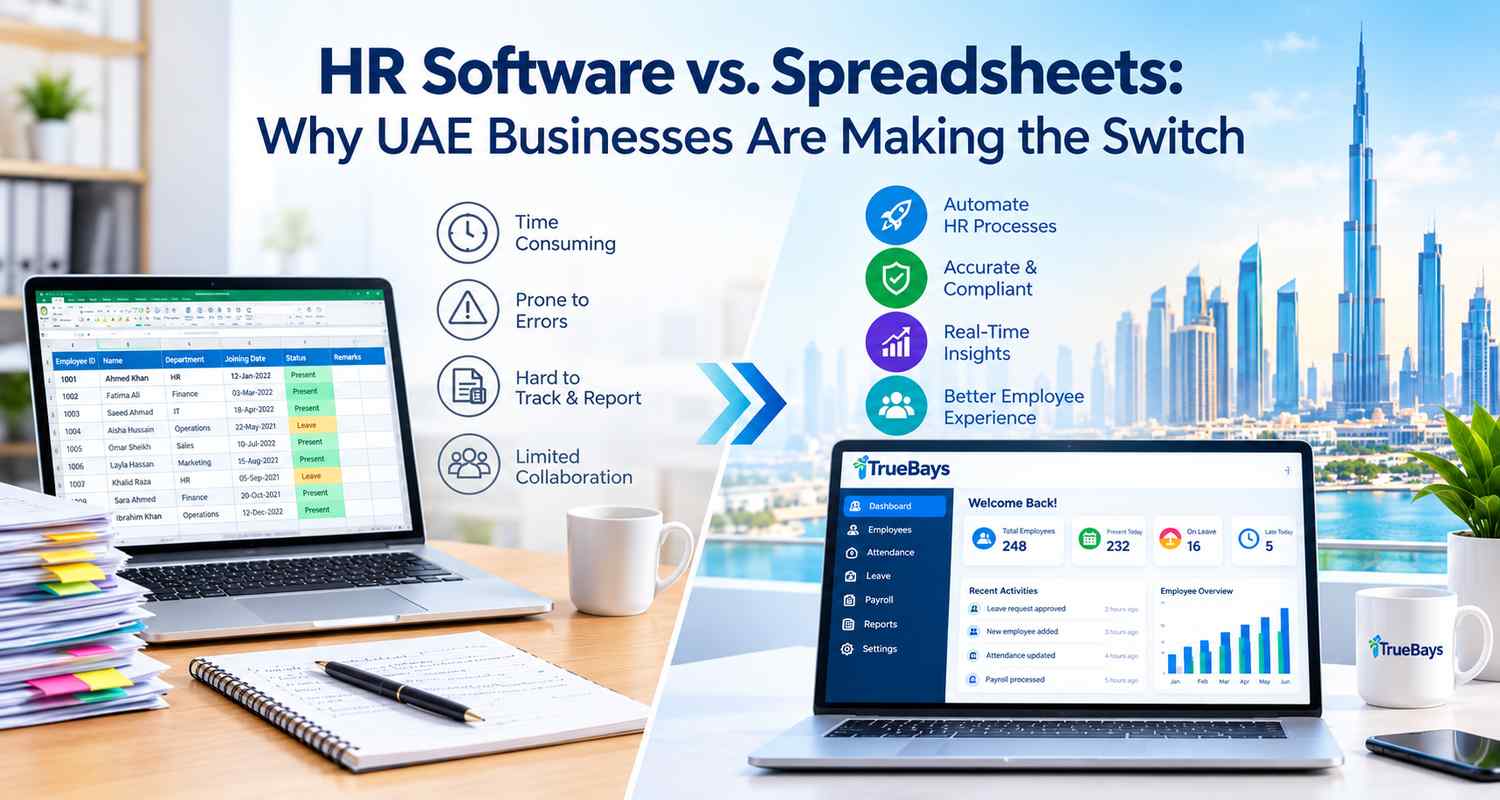
HR Software vs. Spreadsheets: Why UAE Businesses Are Making the Switch
For many businesses, Excel spreadsheets are where HR management starts. Employee information is entered into a spreadsheet. Leave is tracked in another file. Attendance may come from a biometric machine and then be exported to Excel. Payroll is calculated separately, while documents and employee records may be stored in folders or shared drives.
When a company has a small team, this approach can appear perfectly manageable. The problem usually starts when the business grows. More employees mean more records, more leave requests, more attendance data, more payroll calculations and more chances for information to be entered incorrectly. What once took an HR administrator a few minutes can eventually take hours every week.
This is one of the main reasons UAE businesses are moving from spreadsheets to dedicated HR software.
Modern HR systems can bring employee records, attendance, leave, payroll, recruitment and other HR processes together in one platform. For UAE companies, this can also help simplify processes related to WPS payroll, gratuity, attendance and employee documentation.
So, is HR software really better than spreadsheets? Let’s look at the practical differences.
Why Do UAE Businesses Still Use Spreadsheets for HR?
Spreadsheets are popular for a simple reason: almost everyone knows how to use them. There is no complicated implementation process. A business can create an employee list, add columns for salary and leave, and start working immediately.
For a very small company, spreadsheets may be enough for basic tasks such as:
- Maintaining a simple employee list
- Recording joining dates
- Tracking annual leave
- Preparing basic salary calculations
- Maintaining contact information
- Creating simple attendance records
The problem is not the spreadsheet itself. The problem is relying on spreadsheets when HR processes become more complicated. Imagine a company with 100 employees across two or three locations. HR now needs to track attendance, overtime, leave, salary changes, employee documents and payroll information.
At this stage, several spreadsheets may be involved. Different people may update different files, and information may need to be copied from one sheet to another. That is where errors and delays start becoming difficult to control.
What Is HR Software?
HR software is a centralized system designed to manage employee and HR processes digitally. Instead of maintaining separate spreadsheets for different tasks, HR teams can manage employee information through a single platform.
Depending on the system, this can include:
- Employee records
- Payroll
- Attendance
- Leave management
- Recruitment
- Employee self-service
- Performance management
- Benefits
- Gratuity
- HR reports
- Document management
For UAE businesses, a good HR system should also support local requirements such as WPS payroll and UAE labour-related calculations. For example, TrueBays StackHX brings employee management, payroll, attendance and other HR functions together in one platform. The system is designed for UAE businesses ranging from smaller companies to larger organizations.
You can learn more about HR software in Dubai and the UAE.
HR Software vs. Spreadsheets: The Key Differences
HR Process | Spreadsheets | HR Software |
Employee records | Manually maintained | Centralized database |
Leave management | Manual entries | Automated requests and approvals |
Attendance | Import/export or manual entry | Can connect directly with attendance systems |
Payroll | Manual calculations | Automated calculations |
WPS | Separate preparation | WPS-ready payroll workflows |
Employee access | Usually handled by HR | Employee self-service portal |
Reports | Created manually | Generated from live data |
Data updates | Multiple files may need updating | Centralized updates |
Access control | Basic file permissions | Role-based access |
| Scalability | Becomes difficult with growth | Designed to scale |
The difference becomes particularly important when multiple HR processes depend on the same information.
1. Employee Data Becomes Easier to Manage
An employee’s information rarely stays limited to their name and phone number.
HR may need to maintain:
- Personal details
- Job information
- Salary
- Joining date
- Leave balance
- Attendance
- Documents
- Bank details
- Visa information
- Emergency contacts
- Employment history
With spreadsheets, this information may end up spread across multiple files. A centralized HR system gives HR teams one place to manage employee information. This also reduces the need to repeatedly enter the same information into different files. For a growing business, that can make a noticeable difference.
2. HR Software Reduces Manual Data Entry
One of the biggest weaknesses of spreadsheets is that many processes depend on manual data entry.
For example, an HR employee may need to:
- Download attendance data.
- Open an Excel file.
- Check late arrivals.
- Calculate overtime.
- Update another payroll spreadsheet.
- Check approved leave.
- Make salary adjustments.
- Prepare payroll.
Every manual step creates another opportunity for an error. With an integrated HR system, information can move between connected HR functions automatically.
TrueBays StackHX, for example, connects attendance with payroll so working hours, overtime, leave and related information can flow into the payroll process without repeatedly transferring data between spreadsheets.
3. Attendance Management Is Easier to Automate
Attendance is another area where spreadsheets can become difficult to manage.
This is particularly true for businesses with:
- Multiple branches
- Construction sites
- Field employees
- Shift workers
- Retail stores
- Hotels and restaurants
- Large workforces
Modern attendance systems can connect with biometric devices, mobile applications and other attendance methods.
For example, TrueBays StackHX supports biometric attendance, mobile GPS attendance, geofencing, RFID and shift management. Attendance information can then be connected to payroll. This eliminates much of the manual work involved in collecting and consolidating attendance records.
For businesses looking for a centralized time and attendance software in the UAE, this type of integration can be especially useful.
4. Payroll Becomes Less Dependent on Excel
Payroll is probably one of the areas where spreadsheet mistakes can have the biggest impact. A small mistake in attendance, overtime, leave or deductions can affect an employee’s salary. For UAE companies, payroll also needs to account for WPS requirements and other local payroll considerations.
A dedicated payroll software solution for UAE businesses can bring salary calculations, attendance, leave, deductions, allowances and WPS processes into a structured workflow.
Instead of manually copying information from an attendance spreadsheet into a payroll spreadsheet, connected systems can transfer the relevant information automatically. That does not mean HR should stop reviewing payroll. It means HR can spend more time reviewing the results instead of manually building them.
5. Leave Requests and Approvals Become Simpler
Consider a common situation. An employee sends HR a WhatsApp message asking for annual leave. HR checks the employee’s spreadsheet to see the remaining balance. The manager then approves the request through email or another message.
Someone eventually updates the spreadsheet. This may work with a small team, but it becomes difficult to manage as the workforce grows. With HR software, employees can submit leave requests through a portal or mobile application. Managers can review and approve them, while the employee’s leave balance is updated within the system.
Employee self-service can also reduce routine HR questions about leave balances, payslips and documents.
TrueBays StackHX’s ESS platform is connected with payroll, attendance and the wider HR system, allowing employees to handle several routine HR activities themselves.
Businesses can also explore employee self-service software in Dubai to see how this approach works.
6. HR Reports Can Be Generated Faster
HR teams often need reports at short notice.
Management may ask:
- How many employees do we currently have?
- Which employees are absent?
- What is our overtime cost?
- How much leave has been taken?
- What is our gratuity liability?
- Which employee documents are expiring?
- How much are we spending on payroll?
With spreadsheets, preparing these reports may require combining information from multiple files. An HR system can generate HR reports using centralized workforce data.
For example, HR software can bring together payroll, attendance and employee information to provide reports without requiring HR to manually consolidate separate spreadsheets. This is particularly useful for managers who need current information to make decisions.
7. Spreadsheets Become Riskier as the Company Grows
A spreadsheet may work well for 10 employees. But what happens when the company reaches 50, 100, 300 or 1,000 employees?
The number of records increases.
The number of HR processes increases.
More people need access to the information.
More employees work from different locations.
More attendance data needs to be processed.
More payroll variables need to be considered.
At some point, the spreadsheet is no longer saving time. It is creating additional administrative work. This is often the point where businesses start looking for an HR management system in the UAE.
When Should a UAE Business Move From Spreadsheets to HR Software?
There is no fixed employee number at which every company needs HR software. The better question is whether the current process is still manageable.
Your business may be ready for HR software if:
- HR spends several hours every month updating spreadsheets.
- Attendance and payroll require manual data transfers.
- Employees frequently ask HR for leave balances or payslips.
- Managers depend on HR for simple approvals.
- Payroll calculations are becoming difficult to verify.
- You have employees working across different locations.
- You use multiple spreadsheets for different HR processes.
- Management frequently asks for HR reports.
- Employee information is duplicated across different files.
- Your workforce is growing quickly.
Even a relatively small company can benefit if its HR processes are becoming complicated.
TrueBays also offers an HR platform designed for small businesses and startups that do not yet have a dedicated HR department.
Is HR Software More Expensive Than Using Excel?
At first glance, Excel appears cheaper. The software may already be available to the business, while HR software involves a subscription or implementation cost. But the comparison should not stop at the software price.
Businesses should also consider the cost of:
- HR staff time
- Payroll errors
- Repeated data entry
- Manual attendance processing
- Delayed reports
- Duplicate records
- Payroll corrections
- Employee queries
- Time spent preparing documents
If HR employees spend several hours every week maintaining spreadsheets, that time has a cost. Automation can reduce some of this administrative workload and allow HR teams to focus on activities that require human judgment.
The goal is not simply to replace Excel. The goal is to reduce unnecessary manual work.
Can Businesses Still Use Excel After Implementing HR Software?
Yes. Moving to HR software does not mean Excel suddenly becomes useless.
Excel can still be useful for:
- Custom analysis
- One-time calculations
- Data preparation
- Management presentations
- Special reports
- Data exports
The difference is that Excel no longer has to act as the company’s main HR database. The HR system becomes the primary source of employee information, while Excel can be used when a specific analysis or format is required. That is a much more sustainable approach for a growing business.
What Should UAE Businesses Look for in HR Software?
Before choosing an HR system, businesses should look beyond the number of features listed on a brochure. Consider whether the software supports your actual HR workflow.
Important areas to check include:
- UAE Payroll and WPS
If the company processes salaries in the UAE, check whether the payroll system supports WPS and SIF requirements.
- Attendance Integration
If you already use biometric devices, check whether the HR software can integrate with your existing hardware.
- Leave Management
Look for automated leave requests, approvals and balance calculations.
- Employee Self-Service
An ESS portal can reduce routine HR requests by allowing employees to access relevant information themselves.
- Reporting
Check whether the system provides the reports your HR and management teams actually need.
- Scalability
The system should be able to support the business as employee numbers and locations increase.
- Security and Access Control
Employee and payroll information is sensitive. Make sure users can access only the information relevant to their role.
- Local Support
For UAE businesses, local implementation and support can be valuable, particularly when dealing with payroll and compliance-related processes.
HR Software Is About More Than Replacing Spreadsheets
The biggest benefit of moving from spreadsheets to HR software is not simply having a nicer interface.
It is the ability to connect HR processes.
An employee’s attendance can affect overtime.
Attendance and leave can affect payroll.
Payroll information can be made available through employee self-service.
Employee records can support reporting and management decisions.
When these processes operate separately in spreadsheets, HR spends time moving information between them. When they are connected, the process becomes much more streamlined. That is the real reason many growing UAE businesses are moving toward automated HR systems.
Why UAE Businesses Are Moving Toward Integrated HR Systems
The shift from spreadsheets to HR software is not happening simply because businesses want newer technology.
It is largely driven by the practical demands of managing a growing workforce. UAE businesses increasingly need to manage payroll, attendance, leave, employee records, WPS processes and employee requests with greater accuracy and less manual work. An integrated HR platform can bring these processes together.
TrueBays StackHX, for example, combines HR management, payroll, attendance and employee self-service within one platform, with features designed around UAE business requirements. For a small company with a handful of employees, spreadsheets may still be sufficient.
For a growing business, however, continuing to manage everything manually can eventually become more expensive than moving to an automated system.
Final Thoughts
Spreadsheets are not bad. In fact, they are useful tools and will probably remain part of business operations for a long time. The problem begins when a spreadsheet is expected to manage an entire HR operation. As employee numbers increase, manual attendance records, leave tracking, payroll calculations and employee data management become harder to maintain accurately.
HR software provides a more structured alternative. It gives businesses a central place to manage employee information and can connect important processes such as attendance, leave, payroll and employee self-service.
For UAE businesses that are growing beyond the point where spreadsheets are comfortable to manage, moving to an HR system can be a practical step toward reducing administrative work and improving HR accuracy.