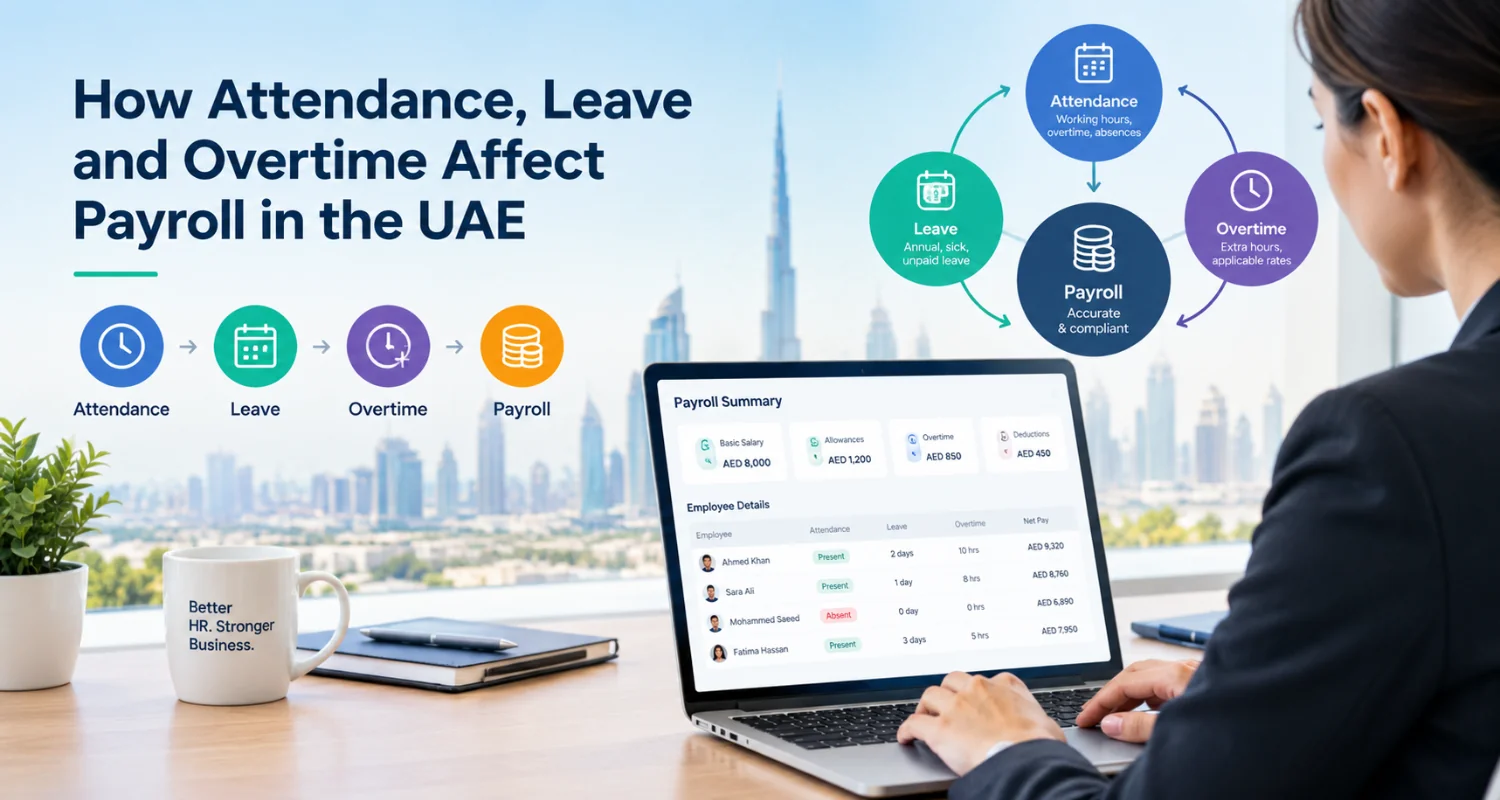
How Attendance, Leave and Overtime Affect Payroll in the UAE
Payroll processing may look like a simple process from outside. Calculate salaries, make deductions, prepare the payment file and pay employees. In practice there is much more to it. An employee’s final salary be determined by the number of days worked, approved leave, unpaid absence, overtime, allowances, deductions and other payroll rules. If the attendance or leave information going into payroll is incorrect, the salary calculation can also be wrong.
This is why attendance, leave and overtime are closely connected to payroll.
For UAE businesses, the connection is very important because payroll also needs to fit within local employment and WPS rules.
Many companies still handle these tasks with a mix of spreadsheets, attendance‑machine exports, emails and separate payroll files. This method can work when the workforce is small. It gets harder as the number of employees and locations grows.
An integrated HR system can bring attendance, leave and payroll together, reducing the amount of manual data entry between departments.
How Does Attendance Affect Payroll?
Attendance provides one of the basic sets of information used during payroll processing. It tells the company whether an employee was present, absent, late, on leave or working additional hours. For employees who receive a fixed salary attendance may not change their pay each time they are late or absent. Still attendance can influence payroll in areas such as:
- Unpaid absence
- Overtime
- Late deductions where applicable
- Shift allowances
- Working days
- Holiday or rest-day work
- Attendance-based allowances
- Payroll adjustments
This is why accurate attendance records matter. Imagine an employee has worked 12 hours of approved overtime during a month. If those hours are missing from the attendance record, they may also be missing from payroll. The opposite can happen too. If attendance records contain duplicate or incorrect overtime entries, payroll could calculate more than the employee actually worked. Therefore the link between the two systems must be reliable.
TrueBays StackHX connects time and attendance data with payroll, allowing attendance information, overtime and related rules to flow into the payroll process instead of being manually transferred between spreadsheets.
Why Manual Attendance-to-Payroll Processing Can Cause Problems
A common payroll workflow in a smaller company might look like this:
Biometric device → Excel export → HR checks attendance → Overtime calculated manually → Payroll spreadsheet updated → Salary processed
There are several points where something can go wrong.
An employee might forget to check in. A manager might approve an attendance correction late. HR might accidentally enter an incorrect number of overtime hours. Someone may use an older version of the spreadsheet.
These problems do not always come from a big system failure. They usually arise from many manual steps. As the workforce grows these small risks become bigger. An integrated system can cut the number of times HR must move the data from one place to another.
How Does Leave Affect Payroll in the UAE?
Leave and payroll are closely connected because different types of leave can have different effects on an employee’s pay. Annual leave, sick leave, unpaid leave and other approved leave types should therefore be recorded accurately and reflected correctly in the payroll process.
Under UAE Federal Decree-Law No. 33 of 2021, employees are entitled to annual leave with full wage subject to the applicable entitlement rules. The law provides 30 days for each year of extended service and two days per month where the employee’s service is more than six months but less than one year.
Sick leave follows a different structure. After the probationary period, an employee may be entitled to up to 90 days of sick leave per year, with the first 15 days at full pay, the following 30 days at half pay and the remaining period unpaid, subject to the law’s conditions.
This is one reason why simply maintaining a list of leave dates is not enough.
The payroll system needs to know what type of leave was taken and how that leave should affect the employee’s pay.
Annual Leave and Payroll
Annual leave generally does not mean that an employee’s normal salary simply stops for the days they are away.
Under the UAE Labour Law, workers are entitled to wages for their annual leave period, subject to the applicable rules.
However, annual leave still needs to be accurately recorded.
For example, an employee may have:
- 30 days of annual leave entitlement
- 8 days already taken
- 22 days remaining
If HR’s spreadsheet says 22 days but the actual approved leave records show 20 days remaining, the difference can create confusion later.
The issue becomes even more important when an employee leaves the company and has unused annual leave.
The law provides for compensation for accrued leave in relevant circumstances, with the calculation based on the basic wage as specified by the law.
A properly integrated leave and payroll system can keep these records connected.
Sick Leave and Salary Calculations
Sick leave is another area where payroll needs accurate information.
The UAE Labour Law provides a three-stage pay structure after the probationary period:
- First 15 days: full pay
- Following 30 days: half pay
- Remaining period: unpaid
This applies subject to the conditions set out in the law.
For HR teams managing this manually, the calculation can become difficult when employees take sick leave at different points throughout the year.
The system needs to know how much eligible sick leave the employee has already used.
An automated leave-management system can maintain the leave history and provide the relevant information to payroll.
TrueBays StackHX supports UAE leave types and connects approved leave information with payroll calculations.
How Does Overtime Affect Payroll in the UAE?
Overtime is an example of why attendance and payroll must work together. If an employee works beyond hours and those extra hours qualify as overtime the overtime must appear in payroll according to the rules.
Under Article 19 of Federal Decree-Law No. 33 of 2021, overtime is generally compensated at the normal working-hour wage calculated according to basic wage, plus an increase of at least 25%. The law provides a higher increase for certain overtime worked between 10 pm and 4 am, with an exception for shift workers, and separate rules apply to work on designated rest days. Businesses can refer to the UAE Ministry of Human Resources and Emiratisation (MOHRE) for official labour-law information and updates.
This is why simply recording that an employee “worked late” is not enough.
Payroll needs reliable information about:
- Normal working hours
- Actual hours worked
- Approved overtime
- Applicable overtime category
- Employee’s basic wage
- Relevant company policies
- Applicable legal rules
The attendance system is often where the original working-time data comes from.
How WPS Fits Into the Payroll Process
For many UAE businesses, payroll does not end when the salary calculation is complete.
The company also needs to process salary payments through the appropriate mechanism.
Under the UAE Labour Law, establishments registered with MOHRE are required to pay wages on their due dates through the Wages Protection System or another system approved by the Ministry, subject to the applicable rules.
This makes accurate payroll preparation particularly important.
If attendance, leave or overtime data is incorrect, the problem can move downstream into the payroll and salary-payment process.
A connected payroll platform can help reduce manual transfers and provide a clearer record of how salary figures were calculated.
TrueBays StackHX supports WPS SIF file generation and integrates payroll with attendance and leave data.
Businesses interested specifically in this area can explore our payroll software for UAE businesses.
How HR Software Helps Reduce Payroll Errors
An integrated HR platform cannot replace proper payroll review, but it can reduce many repetitive tasks.
For example, HR software can help businesses:
- Centralize employee information
Employee records, attendance, leave and payroll information can be maintained within the same platform.
- Automate attendance calculations
Working hours and overtime can be calculated according to configured rules.
- Connect approved leave with payroll
HR does not have to repeatedly copy leave information between separate files.
- Reduce spreadsheet dependency
Fewer manual transfers mean fewer opportunities for data-entry mistakes.
- Improve visibility
HR and management can access reports covering attendance, leave, overtime and payroll information.
For businesses using biometric attendance machines, integration is also important. TrueBays supports biometric attendance machine integration with its HR and attendance system.
Final Thoughts
Attendance, leave and overtime are not separate from payroll. They are some of the inputs that help determine what an employee should be paid. For UAE businesses, managing these processes manually can become increasingly difficult as employee numbers, locations and working patterns grow.
An integrated HR system can bring these processes together so that attendance data, approved leave and overtime information can flow into payroll without repeated spreadsheet transfers. The result is a more structured payroll workflow, fewer opportunities for manual data-entry errors and better visibility for HR and finance teams.
For businesses looking to connect these processes, an HR software can provide a centralized platform for employee management, attendance, leave and payroll. TrueBays StackHX brings these HR functions together, including time and attendance software in the UAE, leave management and WPS payroll processing.
The goal is not simply to automate payroll. It is to make sure the information behind payroll is accurate, connected and easier to manage.
Frequently Asked Questions
- Does attendance affect payroll in the UAE?
It can. Attendance records can provide information about working hours, absences, overtime and other payroll-related adjustments, depending on the company’s policies and payroll structure.
- Does leave affect salary in the UAE?
The effect depends on the type of leave and the applicable UAE employment rules. Annual leave, sick leave and unpaid leave can have different implications, so they should be recorded using the correct leave category.
- How does overtime affect payroll in the UAE?
Approved overtime can increase an employee’s payable amount according to the applicable UAE rules and company policies. Accurate attendance records help HR identify and process overtime correctly.
- Can attendance software connect with payroll?
Yes. Many modern HR systems can integrate attendance and payroll so that approved working hours and overtime information can be used during payroll processing.
- Why should UAE businesses integrate attendance and payroll?
Integration reduces manual data entry and makes it easier to keep attendance, leave, overtime and payroll information consistent.
Disclaimer
This article is provided for general informational purposes and should not be considered legal or payroll advice. UAE employment regulations and related requirements may change. Businesses should refer to the latest guidance from MOHRE or consult a qualified professional for specific employment and payroll matters.