
UAE Labour Law 2026: The Complete Guide for HR Managers in Dubai & UAE
If you manage HR for a company in Dubai or anywhere across the UAE, Federal Decree-Law No. 33 of 2021 is the single most important piece of legislation on your desk. Enacted in February 2022 and updated with further ministerial decisions through 2024 and 2025, this law fundamentally changed the employment relationship in the UAE not just for new hires, but for every employee currently on your payroll.
The challenge most HR managers face is not a lack of awareness. Most people know the headline changes fixed-term contracts, the new gratuity calculation, updated leave entitlements. The real challenge is implementation: making sure your employment contracts are worded correctly, your payroll system calculates gratuity under the new rules, your leave records reflect the updated entitlements, and your termination procedures are watertight if a case ever reaches MOHRE.
This guide covers the rules, explains what they mean in practice, highlights the areas where companies most commonly get it wrong, and tells you what to fix before it becomes a problem.
1. Employment Contracts — The End of Unlimited Contracts
The most structural change under Decree-Law No. 33 is the complete abolition of unlimited (open-ended) contracts. Every employment relationship in the UAE must now be governed by a fixed-term contract. If you still have employees on unlimited contracts and many UAE companies do, particularly longer-serving staff hired before 2022 those contracts needed to be converted by the end of the transition period.
Fixed-term contracts are typically set for one, two, or three years and are renewable. The key practical implication is contract renewal management. In a company of 50+ employees, contracts expire at different times throughout the year. Missing a renewal does not automatically terminate employment, but it creates ambiguity in the employment relationship and can complicate any subsequent disciplinary or termination proceedings.
Probation period rules have also been updated. The maximum probation period remains six months. However, the notice requirements during probation are now clearly defined in a way the previous law was not:
- If the employer wishes to terminate during probation: 14 days written notice is required.
- If the employee wishes to resign during probation to join another UAE employer: 1 month written notice is required.
- If the employee resigns during probation to leave the UAE entirely: 14 days written notice is required.
This distinction matters. If an employee on probation resigns to join a competitor in the UAE without serving the one-month notice, the new employer can face restrictions on processing that employee’s work permit for a period of time. Many HR managers are unaware of this and inadvertently accept resigning employees without enforcing the correct notice period.
Notice periods for termination after probation are now also standardised at a minimum of 30 days, with contracts allowed to specify up to 90 days. One-sided notice where the employer specifies a 90-day notice requirement for the employee but only 30 days for themselves is not legally sound under the new law’s spirit of equal treatment.
💡 If you are managing contracts for 50+ employees, automated contract expiry alerts are essential. TrueBays StackHX sends notifications 60 days before any contract or visa expiry — giving HR enough time to prepare renewals rather than scrambling at the last minute.
2. Working Hours, Overtime & the Ramadan Adjustment
Standard working hours under UAE labour law remain 8 hours per day and 48 hours per week for most employees. However, the practical application has nuances that catch many HR managers out when calculating monthly payroll.
Overtime rules under Decree-Law No. 33:
- Regular overtime (any overtime beyond 8 hours per day): Basic salary + 25% premium on the hourly rate.
- Night and Friday overtime (work between 10 PM and 4 AM, or any overtime on a Friday): Basic salary + 50% premium on the hourly rate.
- Maximum overtime: Employees cannot be required to work more than 2 hours of overtime per day unless the nature of work or business emergency requires it — and even then, total hours cannot exceed 144 hours over any three-week period.
The calculation that most commonly goes wrong is the hourly rate base. Overtime must be calculated on the basic salary only — not the total package including housing allowance, transport allowance, or any other allowances. Many companies using Excel-based payroll accidentally include total salary in overtime calculations, which overpays employees and creates inconsistency across the payroll run.
During Ramadan, working hours for Muslim employees must be reduced by two hours per day. Non-Muslim employees are not legally required to have their hours reduced, but many UAE companies apply the reduction across the board as a practical accommodation. The Ramadan adjustment applies regardless of whether the employee is fasting.
⚠️ Overtime calculated manually on spreadsheets is one of the most common sources of WPS SIF file errors we see when auditing UAE company payrolls. The WPS system cross-references declared salaries — inconsistencies trigger rejections. Automated time and attendance software eliminates this by calculating overtime based on the correct formula every time.
3. Leave Entitlements — What Changed and What HR Gets Wrong
Leave entitlements under the new law are broadly similar to the previous legislation but with important clarifications that affect how you calculate entitlements and manage requests.
| Leave Type | Entitlement | Pay Rule |
|---|---|---|
| Annual Leave | 2 days per month for first 6 months; 30 days per year after 6 months of service | Full pay |
| Sick Leave | First 15 days | Full pay |
| Next 30 days | Half pay | |
| Next 45 days | Unpaid | |
| Maternity Leave | 45 days | Full pay |
| Additional 15 days | Half pay | |
| Paternity / Parental Leave | 5 working days (within 6 months of birth) | Full pay |
| Bereavement Leave | 5 days (spouse or child); 3 days (other relatives) | Full pay |
| Hajj Leave | 30 days (once per employment) | Unpaid |
| Study Leave | 10 days per year (after 2 years of service, for employees studying at UAE-accredited institutions) | Full pay |
The area where UAE HR teams most frequently make errors is annual leave accrual and encashment. The law states that annual leave should be taken within the year it is earned. However, if the employer postpones leave for operational reasons, the employee retains the right to that leave and can claim encashment upon termination. If your company has been rolling over leave balances for years without a clear policy, accumulated leave liability can become a significant financial exposure that only appears on the balance sheet when an employee resigns.
A second commonly misunderstood area is sick leave during probation. Employees on probation are not entitled to paid sick leave under Decree-Law No. 33. If an employee on probation requires extended sick absence, the situation must be handled carefully the employer cannot simply terminate during illness without following proper procedure, but paid sick leave entitlement does not apply during the probationary period.
🚀 Tip: Stop managing leave through paper forms and email threads. TrueBays ESS Portal allows employees to apply for any leave type from their mobile, managers approve with one tap, and leave balances update automatically in the payroll system.
4. End of Service Gratuity — The Calculation Most Companies Get Wrong
The gratuity calculation under Decree-Law No. 33 is simpler than it was under the previous law — but simplicity has not stopped it from being the most frequently miscalculated employment cost in UAE businesses.
Under the new law, the distinction between resignation and termination has been removed for gratuity purposes. An employee who resigns after completing one year of service is entitled to the same gratuity as one who is terminated. The previous graduated reduction for resignees (50% after 1–3 years, 66% after 3–5 years) no longer applies.
The current gratuity formula:
- Less than 1 year of service: No gratuity entitlement.
- 1 to 5 years of service: 21 days of basic salary for each year completed.
- Over 5 years of service: 30 days of basic salary for each year completed beyond 5 years (the first 5 years continue to be calculated at 21 days per year).
Example calculation for a 7-year employee:
Assume a basic salary of AED 5,000 per month.
- Daily basic salary = AED 5,000 ÷ 30 = AED 166.67
- First 5 years: 5 × 21 days × AED 166.67 = AED 17,500.35
- Years 6 and 7: 2 × 30 days × AED 166.67 = AED 10,000.20
- Total gratuity = AED 27,500.55
The two most common calculation errors we see in practice: first, companies using total salary (including allowances) instead of basic salary — this overstates gratuity significantly for employees with large allowance packages. Second, companies failing to deduct days of unpaid leave from the service period — the law is explicit that unpaid leave does not count toward the gratuity service period.
One more important point: gratuity is capped at 2 years’ total wages. For very long-serving employees this cap becomes relevant and must be applied correctly.
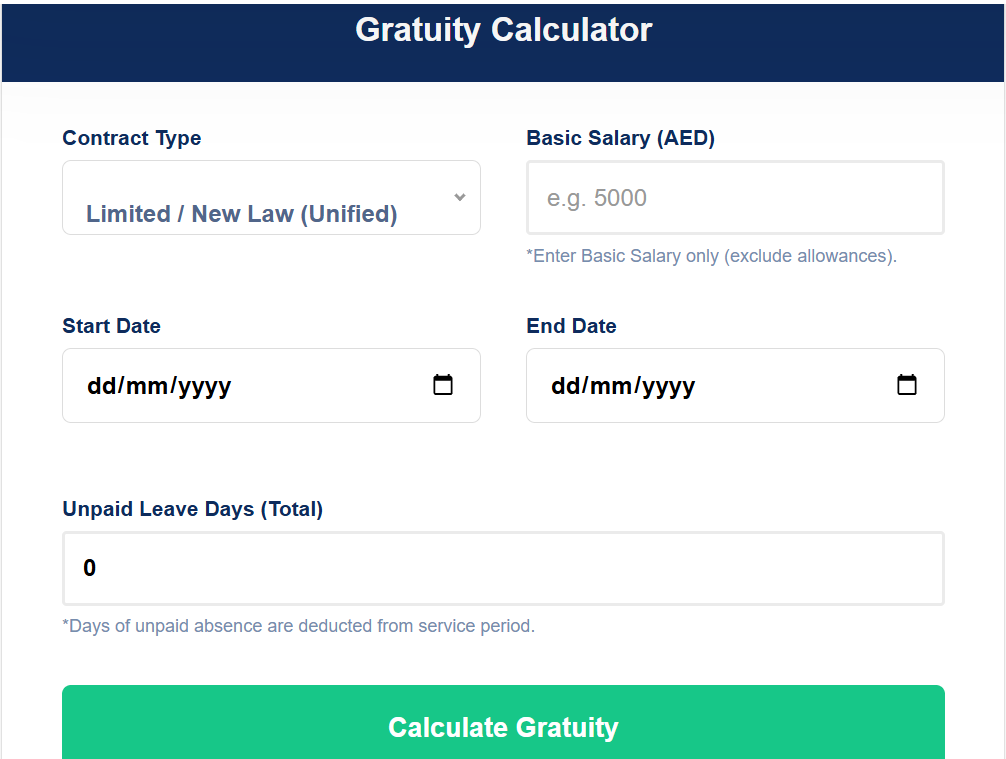
🧮 Use our Free UAE Gratuity Calculator to calculate accurate end-of-service entitlements instantly based on the Decree-Law No. 33 formula.
5. Termination, Arbitrary Dismissal & MOHRE Disputes
This is the area of UAE labour law where the financial exposure for employers is highest — and where proper HR record-keeping makes the biggest difference.
Under Decree-Law No. 33, arbitrary dismissal occurs when an employer terminates an employee for reasons unrelated to work performance or conduct. If a MOHRE complaint is filed and the dismissal is found to be arbitrary, the employer can be ordered to pay compensation of up to 3 months’ total wage in addition to the standard end-of-service gratuity and any outstanding leave entitlements.
Legitimate grounds for termination without arbitrary dismissal liability include poor performance (with documented warnings), misconduct, absence without authorisation for a defined number of days, or genuine redundancy. The key word in all of these is documented. A verbal warning that is not recorded in the employee’s HR file has no standing in a MOHRE dispute. A performance improvement plan that was discussed but never formally issued is effectively invisible to a labour inspector.
Regarding disciplinary procedures and salary deductions: employers may impose penalties for employee violations, but salary deductions for disciplinary reasons cannot exceed the equivalent of 5 days’ pay per month. Deductions above this threshold are unlawful regardless of the severity of the infraction, and are one of the more common triggers for MOHRE complaints from employees.
Notice periods must be honoured by both parties. An employer who wishes to terminate with immediate effect (pay in lieu of notice) must pay the full notice period salary. An employee who abandons their role without serving notice can face a work ban, but the employer’s right to compensation for the unserved notice period must be pursued through proper channels rather than withheld from the final settlement without agreement.
.
6. WPS Compliance — Where Labour Law and Payroll Connect
The Wage Protection System (WPS) is the UAE Ministry of Human Resources mechanism for ensuring employees are paid accurately and on time. Every UAE private sector employer must process salaries through a WPS-approved bank or exchange house and submit a correctly formatted SIF file each month.
WPS compliance failures carry escalating penalties. A first violation results in a warning and suspension of new work permit applications. Repeat violations result in fines and can affect your company’s MOHRE classification which directly impacts your ability to hire new staff at a time when you may need it most.
The connection between labour law compliance and WPS is direct. If your overtime calculations are wrong, your SIF data will be wrong. If your leave deductions are miscalculated, your net salary payments will be inconsistent with your declared figures. These discrepancies are increasingly flagged by MOHRE’s automated cross-referencing systems, and the first you may hear about it is when your work permit applications are rejected.
⚠️ TrueBays StackHX generates WPS SIF files automatically from your payroll run — correctly formatted for all UAE-approved WPS banks including Emirates NBD, FAB, ADCB, and others. Use our free WPS SIF Generator tool to understand the file format before your next payroll cycle.
7. The 2024–2025 Ministerial Updates HR Managers Need to Know
Federal Decree-Law No. 33 of 2021 was the framework legislation, but MOHRE has issued several ministerial decisions since then that HR managers need to be aware of:
Remote and flexible work: Ministerial Decision No. 47 of 2022 introduced formal frameworks for remote work, part-time employment, temporary work, and flexible hours contracts. These are now recognised employment forms with specific contract templates — not informal arrangements. If your company has employees working remotely or on flexible schedules without a formal flexible work contract in place, those arrangements are not properly documented under UAE law.
Non-compete clauses: The law now places specific limits on non-compete restrictions. They must be limited in geographic scope, duration (maximum 2 years), and industry — and must be justified by the employee having access to genuinely sensitive business information or client relationships. Blanket non-compete clauses applied to all employees regardless of role are not enforceable.
Employment of domestic workers: Covered separately under Federal Law No. 10 of 2017 with its own rules on working hours, leave, and termination. This is a distinct framework from Decree-Law No. 33 and applies to companies or families employing domestic staff directly.
Staying Compliant in 2026 — Practical Steps
UAE labour law compliance is not a one-time task. It requires ongoing attention as ministerial decisions are updated, as your employee base grows, and as individual situations arise through the year.
The companies that manage this well are not necessarily the ones with the most experienced HR managers. They are the ones with systems in place. Automated contract renewal alerts mean no contract lapses. Digital leave records mean every entitlement is tracked and every approval is documented. Payroll software that calculates gratuity, overtime, and deductions according to the correct legal formula means the numbers are right every month without manual checking.
From our experience implementing HR systems across UAE companies, the three areas that generate the most MOHRE disputes are: miscalculated or underpaid gratuity at termination, missing documentation for disciplinary actions, and WPS errors from incorrect overtime or deduction calculations. All three are preventable with the right systems.
If you want to review where your company stands against these requirements, contact TrueBays for a free HR system audit. We review your current payroll setup, contract formats, and leave management processes against the current Decree-Law No. 33 requirements — and tell you specifically what needs to be addressed.
Related resources:
- Free UAE Gratuity Calculator — Decree-Law No. 33 Formula
- WPS SIF File Generator Tool
- UAE Payroll Software with WPS Integration
- HR Software Dubai — Full HRMS for UAE Businesses
- Time & Attendance Software UAE — Overtime Calculation Automated